
Remembering The Mills Brothers
"The act that changed the vocal group scene forever"

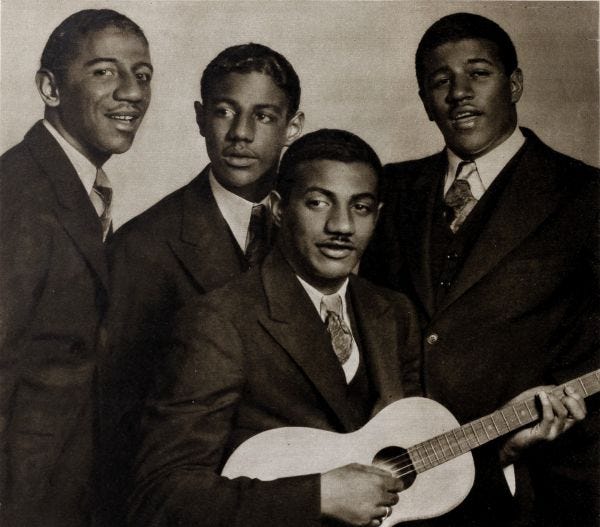

The Mills Brothers were an iconic American vocal jazz and traditional pop vocal group that enjoyed a career spanning more than 50 years, from the mid-1920s to the early 1980s. They are recognized as pioneers who broke racial barriers in the music industry.
From The Billboard book of American singing groups : a history, 1940-1990:
The act that changed the vocal group scene forever was the Mills Brothers (1931) of Piqua, Ohio. They were four brothers who were inspired not just by previous vocal groups but by the orchestral arrangements and jazz instrumental work of Duke Ellington and Louis Armstrong. Their style of rhythm and blues with touches of jazz was so popular that they were the inspiration for more vocal groups than any other (with the possible exception of the Ink Spots). Their new style of singing combined the vocal imitation of wind instruments with a smooth harmony sound that attracted both white and black audiences, making them the first truly popular vocal group in the nation.
The four brothers, Herbert, Donald, Harry, and John Mills Jr. began as children as a barber shop quartet, singing in their father’s barbershop. Their father, John Mills Sr., was also a singer. He sang with a group called the Four Kings of Harmony.
From the 1986 documentary The Mills Brothers Story:
(Donald) We started singing barber shop because our father at one time had a barber shop quartet. They were called the Four Kings of Harmony, and this is where we learned Barber Shop Harmony from them. But actually we used to do a lot of Barber Shop singing yes. But not necessarily just the barber shop.
(Harry) Basically as you ask about Barber Shop quartet. It’s what is called four part harmony, which is bass, baritone, lead, and tenor as your four-part harmony. And all quartet is called barber shop harmony it’s the original idea. And that is our first teaching, four-part Harmony. You see, originally we were four brothers. Our eldest brother sang bass. I sing Baritone. Donald sings the lead, and Herbert sings tenor. And we still sing the three-part Harmony today, right to this day, that’s basically our Harmony.
The brothers began performing at the local opera house and even on street corners imitating instruments with kazoos. In one performance during the 1920s Harry forgot his kazoo and began improvising the sound of a musical instrument with his voice while cupping his hands over his mouth. The audience response was great, so this became the group’s signature style. John Jr. played the guitar, which is the only actual instrument the group used. As a result, they were also sometimes called “Four Boys and a Guitar.”
In the late 1920s the quartet was signed to perform on a variety of radio shows in Cincinnati. The group’s fame spread to New York, where they wound up on the CBS radio network. William S. Paley, who ran CBS radio in New York, signed the brothers to a three-year contract in 1930. This made them the first African Americans to host a network radio show, and soon after, they also became the first African-American vocal group to gain widespread popularity among white audiences.
By 1931 they were recording for Brunswick Records. The brothers had their first number one record with “Tiger Rag,” in December 1931. They ranged in age from 16 to 20 at the time.
Brunswick had the record labels for the Mills Brothers read, “No musical instruments or mechanical devices used in this recording other than one guitar.”
The Mills Brothers’ chart successes continued through the early 1930s. They recorded several songs with Bing Crosby, including “Dinah,” which went to #1 in 1932.
I’ve posted below the 1932 nine minute Max Fleischer bouncing ball animated short I Ain’t Got Nobody, which includes what is described as the first on screen performances by the Mills Brothers.
The intro text reads:
Presenting for the first time on the screen
Radio’s greatest sensation
THE MILLS BROS.
Note!
The music throughout this cartoon is furnished by the Mills Brothers Quartette.
They employ no musical instruments of any kind -
except the guitar.
There is no tuba, no trumpet and no saxophone.
(Video source: Wikimedia Commons, Public Domain)
The Mills Brothers also performed with Louis Armstrong, Ella Fitzgerald and Cab Calloway. Other 1930s hits included “You Rascal, You”, “I Heard’, ‘Good-Bye, Blues”, “Rockin’ Chair”, “St. Louis Blues”, “Sweet Sue”, “Bugle Call Rag”, “It Don’t Mean A Thing (If It Ain’t Got That Swing)”, “Swing It Sister”, “Sleepy Head” and “Sixty Seconds Together.”
The Mills Brothers also performed in several movies during this time including The Big Broadcast (1932), Operator 13 (1934), and Twenty Million Sweethearts (1934).
In the video below The Mills Brothers perform “How’m I Doin’, Hey, Hey” in the 1934 movie Twenty Million Sweethearts.
While touring in England, John Mills Jr. became sick. He returned to the US and died shortly thereafter in January 1936 at the age of 25. John Sr. then took the place of his son in the group. They also hired a guitarist Norman Brown to take over for John Jr.
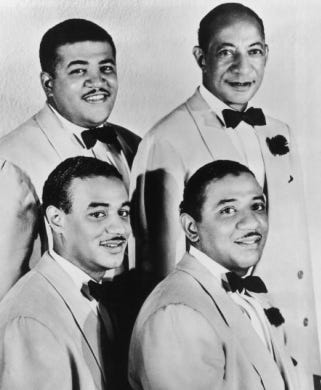

The Mills Brothers had their biggest hit in 1943 with “Paper Doll,” which sold six million copies. The song sat at #1 for three months.
In the video below, the Mills Brothers perform “Paper Doll” in the 1944 movie Cowboy Canteen.
The Mills Brothers continued their chart successes through the 1940s and the 1950s.
In 1952 they had a #2 hit with “Glow Worm.” It was their fifth million selling record.
John Mills Sr. retired in 1956. Herbert, Donald, and Harry continued as a trio, recording into the 1970s and performing into the 1980s.
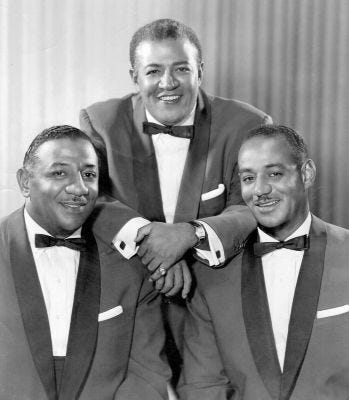

Due to diabetes, Harry started losing his eyesight around 1967 and eventually went nearly completely blind, but he continued to perform. The video below is a 1980 Mills Brothers performance with the Boston Pops.
Harry Mills died in 1982. Herbert and Donald continued to perform with Donald’s son John. Herbert Mills died in 1989. Donald continued performing with his son. Donald Mills, the last living member of the original Mills Brothers died in 1999.
From The Billboard book of American singing groups : a history, 1940-1990:
Mills Brothers were not only the first black vocal group to have wide appeal among whites, they were the most successful American male group of all time, with 71 chart singles (THE ANDREWS SISTERS had 113) spanning four decades.
According to the New York Times in 1981, the Mills Brothers recorded 2246 songs.
The Mills Brothers were inducted in to the Vocal Group Hall of Fame in 1998. They were awarded with the Grammy Lifetime Achievement Award in 1998.
Two of their recordings are in the Grammy Hall of Fame: “Paper Doll” (inducted 1998) and “You Always Hurt The One You Love” (inducted 2017).
I know I posted a lot of videos here, but there are so many good ones, I had to restrain myself from posting more. I think they are all good, but If you don’t have time to watch them all, I recommend watching the on screen performances. They were really good performers.
Nice videos once again. My parents played them. “Glow Worm” is the song I remember the most.